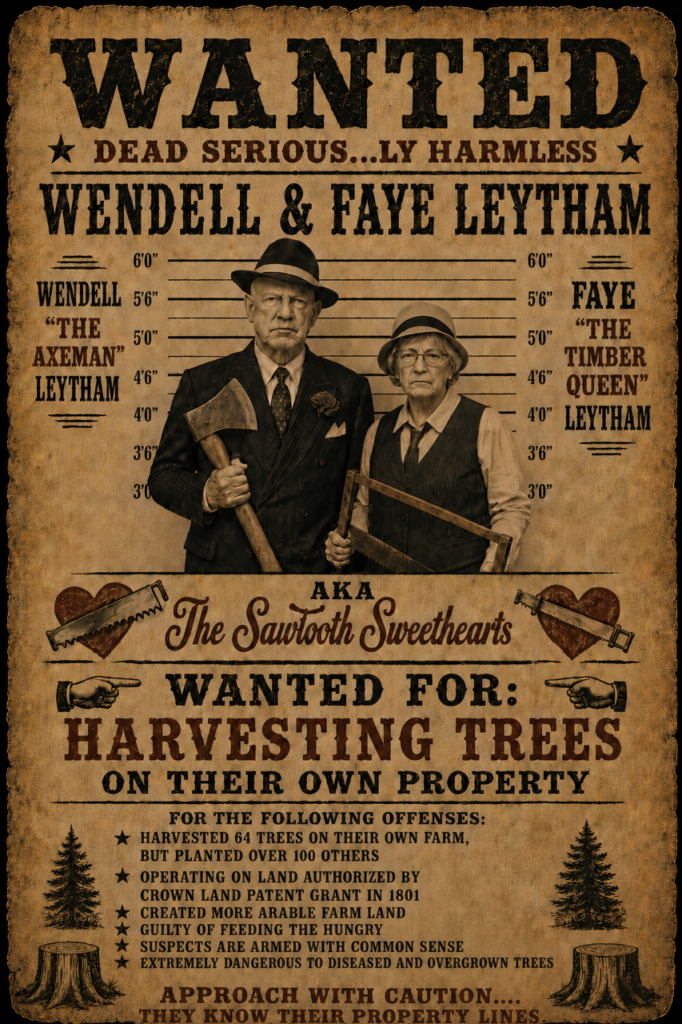
Tree cutting By-laws in Ontario will continue until the province and municipalities understand the difference between destroying or damaging a tree and Harvesting a tree under Normal Farm Practice.
Why?
Because Context Matters.
What is being debated in these cases is often framed in abstract terms:
- “injury to trees”
- “destruction of woodlands”
- “regulatory compliance”
But in the field, on a farm, the same activity is understood very differently:
It is management.
It is silviculture.
It is normal farm practice.
The legal starting point — ownership and use
The legal framework begins with the Crown grant.
Through Letters Patent, land was conveyed into private ownership — including:
- the soil
- the trees
- and the right to use that land productively
The Public Lands Act later confirms that position by eliminating historic Crown reservations over timber, placing ownership of trees firmly with the landowner.
This matters for one reason:
The trees on private agricultural land are not a public resource.
They are part of a privately owned, working agricultural system.
A structured hierarchy of law
From that starting point, a clear legal hierarchy exists:
- Crown grant / property ownership
- Provincial legislation governing land use
- Municipal by-laws exercising delegated authority
That hierarchy is not optional.
It is reinforced in law through a simple and controlling principle:
A lower law cannot interfere with a higher one.
This is reflected directly in section 14 of the Municipal Act:
- A by-law is without effect where it conflicts with provincial legislation
- Including where it frustrates the purpose of that legislation
Agriculture is not just another land use
The Legislature has already spoken clearly on agriculture.
The Farming and Food Production Protection Act defines and protects:
- agricultural operations, including silviculture
- normal farm practice, including accepted and evolving farming methods
This is not incidental language.
It reflects a policy decision:
Agricultural activity is essential and must be protected from interference.
Tree harvesting, in this context, is not an isolated act.
It is often:
- part of land clearing
- part of crop expansion
- part of woodlot management
- integrated into the agricultural use of the land
In short:
It is a continuous normal farm practice.
The municipal approach — regulation through permits
Municipal by-laws approach the same activity through a different lens.
They typically:
- define tree cutting as “injury” or “destruction”
- impose permit requirements
- allow conditions, delays, or refusal
On its face, this is framed as regulation.
But in substance, it operates differently.
A permit system:
- requires prior approval
- creates delay
- introduces uncertainty
- allows discretionary control over a farming decision
This leads to the central issue:
Is this regulation — or is it interference?
The conflict emerges
The conflict is not theoretical.
It arises when:
- a farmer has lawful authority to carry out a normal farm practice
- but must first seek permission from a municipality to do so
At that point, the structure reverses:
- Provincial law says the activity is protected
- Municipal law says the activity requires permission
That is not coexistence.
That is conflict.
Why permits matter in agriculture
Farming is not static.
It operates within real constraints:
- weather
- seasons
- soil conditions
- production cycles
Decisions must often be made quickly.
Tree harvesting, when required, cannot always wait for:
- administrative timelines
- approvals
- external input
A permitting regime that:
- delays action
- imposes conditions
- or risks refusal
does more than regulate.
It interferes with the operation itself.
The role of the Forestry Act
The Forestry Act reinforces an important principle:
- forestry activity on private land is tied to ownership
- and, where regulation applies, it is often linked to:
- agreements
- public investment
- or specific statutory purposes
This supports a broader point:
Not all tree activity on private land is subject to the same level of control.
Common law still governs
None of this places farmers above the law.
The longstanding common law principle remains:
Use your property in a manner that does no harm to your neighbour.
That principle has governed land use for centuries.
It continues to apply today.
But there is a clear distinction:
- preventing harm is legitimate
- controlling lawful activity is something different
A shift in governance
Over time, regulation has expanded.
The movement has been gradual:
- from preventing harm
- to managing activity
- to controlling it
In agriculture, that shift carries real consequences.
Farmers today face:
- rising input costs
- fuel and equipment pressures
- increasing compliance requirements
Each additional layer affects:
- timing
- efficiency
- economic viability
And ultimately:
Food production itself.
Language matters — “destruction” vs “harvesting”
Municipal by-laws describe: “destruction” of trees
Farmers describe: “harvesting”
That difference is not rhetorical.
It reflects two different perspectives:
- an administrative view of land
- an agricultural one
For over 300 years in Ontario, farmers have:
- cleared land
- managed woodlots
- harvested timber as part of agricultural development
That history is not incidental.
It is foundational.
The legal boundary
This article is not about eliminating municipal authority.
Municipalities do have a role.
But that role is defined — and limited — by law.
Where a by-law:
- conditions
- delays
- or restricts
a provincially protected normal farm practice
the issue is no longer policy.
It is legality.
Final point
In the end, this is not a debate about trees.
It is a question of structure:
- ownership
- statutory protection
- delegated authority
and where the limits between them lie.
Because the real issue is simple:
Who has the authority to decide — and within what limits.
Who does … We The People Do !
Jeff Bogaerts
President – Ontario Landowners Association
“… if you do not know what your rights are … then you have no rights …”