

NO Alto Overpass Campaign - be there if you can!
On Friday, August 28, 2026 from 4-6:30 PM, an overpass demonstration is planned by the Tyendinaga Township Landowner Coalition.
"We have selected 14 overpasses with sidewalks and nearby parking. Please review the guidelines included in the sign up form.
Why I’m Fighting Canada’s High-Speed Rail
I’m the mayor of a small city near Ottawa. The $90-billion project could tear my community apart.
By Mario Zanth
August 19, 2026
Last year, in his final days in office, Justin Trudeau announced a new high-speed rail line between Quebec City and Toronto. It would run for 1,000 kilometres, with stops in Peterborough, Ottawa, Montreal, Laval and Trois-Rivières. Trudeau framed the project as a major boost to Canada’s productivity. With trains travelling up to 300 kilometres an hour, passengers could get from Toronto to Montreal in three hours, about half the time it takes on Via Rail. People would save on travel time, businesses would gain access to larger markets and workers would gain access to more jobs. The productivity boost, the government said, could add as much as $35 billion to Canada’s GDP annually. The $90-billion project would also create 51,000 construction jobs, with work expected to begin in 2029. To oversee the project, the government created Alto, a new Crown corporation.
I’m the mayor of Clarence-Rockland, a small city about a half-hour drive east of downtown Ottawa, and the warden of the United Counties of Prescott and Russell, a predominantly agricultural region in eastern Ontario that stretches toward the Quebec border. Many of us assumed that any new rail corridor through our area would follow Highway 417, the major route connecting Ottawa and Montreal. The highway runs along the southern part of our region, so we believed the disruption to our farms and residents would be minimal.
Then, last December, the proposed map was released for the first 200-kilometre segment of the line between Montreal and Ottawa. We saw the route wouldn’t be placed neatly alongside an existing highway corridor. Instead, we were shocked to discover that it would run farther north, cutting straight through the middle of our region. The rationale was that this would be the most direct route between the two cities—this project was, after all, about saving time.
But that line would require a 60-metre-wide corridor of land, surrounded by fencing 10 to 12 feet high. Picture what that would mean in a rural community like ours: beautiful, pristine farmland divided by what would feel like a wall, with a high-speed train barrelling through it. Farmers wouldn’t be able to simply drive tractors across this corridor. If the nearest crossing was several kilometres away, a farmer might have to take a long detour just to reach land that used to be directly accessible. In some cases, productive farmland could effectively become dormant because it’s no longer reachable.
Some of the land would also have to be expropriated, mostly from farmers. Even if they’re compensated, losing part of a property could limit their ability to expand their operations, complicate their connections to utilities, hurt property values and make the remaining land harder to sell. Municipalities, meanwhile, cannot quickly or cheaply build underpasses and overpasses wherever access is needed. Those are complicated pieces of infrastructure, especially for trains travelling at such high speeds.
Any road that doesn’t go over or under the tracks would have to be closed, diverted or redesigned; in Clarence-Rockland alone, we’ve identified 14 thoroughfares that might have to be dead-ended. If roads are cut off or rerouted, we’ll have to re-evaluate the location of our paramedic stations, fire halls and police services. For paramedics especially, even a few extra minutes caused by a detour can matter.
We’re also alarmed by the federal plan to use existing infrastructure. In our region, that most likely means the old, abandoned rail line between Montreal and Ottawa. That rail line has now been converted into a recreational trail used by cyclists, pedestrians, snowmobilers and ATV riders. It’s a busy route, with 120,000 visitors a year. The possibility that this trail could be taken over has made many residents nervous. It’s now an integral part of the way people gather and enjoy the outdoors.
Then there’s the problem of electricity. Our region’s power grid isn’t always reliable. Dairy and egg farmers depend on equipment and temperature-controlled systems that must run consistently. ATG Industries, a local airplane-parts manufacturer, already deals with regular interruptions that can knock specialized equipment out of calibration, costing the company hundreds of thousands of dollars a year. If the rail line requires a significant new electricity supply, where will that power come from, and what will it mean for the farms, residents and businesses already dealing with an unreliable grid?
These are the kinds of serious, practical questions that residents brought to the project’s public consultations earlier this year. Will I have to sell my home? Will I lose farmland and be compensated if I do? If the corridor cuts off part of my property, will I still be able to access the rest of my land? Will de-icing fluid affect wells or farmland? Alto representatives were often unable to answer. They said the project had not yet reached the stage where they can share details. Ottawa is essentially asking people to live with uncertainty about their homes and businesses, while being told that the answers will come later.
The federal government has also failed to clearly establish the financial case for spending this much taxpayer money on a project that could cause so much disruption to the communities in its path. In 2025, Via Rail sold more than $500 million worth of tickets and still lost $375 million in a single year. Does the government anticipate enough demand for the rail line to break even or turn a profit? How much will a ticket cost? Because if someone is told they can travel from Ottawa to Toronto by high-speed rail for $500, many people will simply say, “No, thanks, I’ll take my car.”
The government must’ve already drawn up projections for demand, ticket prices and revenue. But those figures have not been publicly disclosed, even after repeated requests from me and other mayors. The lack of transparency became even more troubling when Alto, as part of the process it was administering, asked us to sign an NDA. I know the city of Ottawa has signed one, but I said an NDA wouldn’t work for us. They may be common between consultants and private businesses, but elected officials have a different responsibility. We cannot properly represent residents if we are also agreeing to withhold important information about a project that could drastically affect them.
Until the federal government provides real answers, our region will continue to refuse access. We know Ottawa has the legal authority to override us by expropriating the land needed to conduct studies and build the line. But doing so would be destructive to the social fabric of our communities. We hope they do not choose that path.
Instead, we want the federal government to seriously consider another route. During the consultations, a group of engineers volunteered to develop a secondary proposal. Their plan would run the line south from Montreal along Highway 401 through Kingston, with a connection north to Ottawa along Highway 417. From what we saw, the travel times would be relatively similar, and this route would minimize the harm done to our communities.
Many Canadians will think about Japan or Europe, where high-speed rail is part of everyday life, and ask: why is a small-city mayor standing in the way of a potentially transformative nation-building project? I understand their perspective. Anyone who drives on Highway 401 today rarely thinks about the land that had to be expropriated to build it. In that sense, I appreciate why the federal government wants to think big. My community and I are not against progress. But nation-building should not mean community-dividing, and that’s what this project would do in our region.
The larger point is that Canadians deserve far more transparency when billions of taxpayer dollars are being spent. We have already seen—with major projects like Toronto’s $27-billion Ontario Line—how unclear communication can strain communities. Along that route, residents have been caught off-guard by around-the-clock construction noise and tunnel-boring vibrations. A few were stunned to learn that their homes would be expropriated. With high-speed rail, similar problems could be amplified across a 1,000-kilometre corridor.
Canada shouldn’t shy away from big projects that can boost our economy and improve people’s everyday lives. But right now, the high-speed rail feels rushed and unprepared. That’s why the federal government must take the time to consult properly, disclose the information people are asking for and choose a route that makes the most sense.
I’m aware that sometime soon, we will have to move from protesting to negotiating, as the train is coming no matter what. As mayor, my responsibility is to represent everyone in my community—those who hate it, those who love it and those who are indifferent—and to protect the infrastructure we all rely on. At the end of the day, residents are not obstacles to be managed. They deserve to be treated as partners in the process.
Mario Zanth is the mayor of Clarence-Rockland and warden of the United Counties of Prescott-Russell
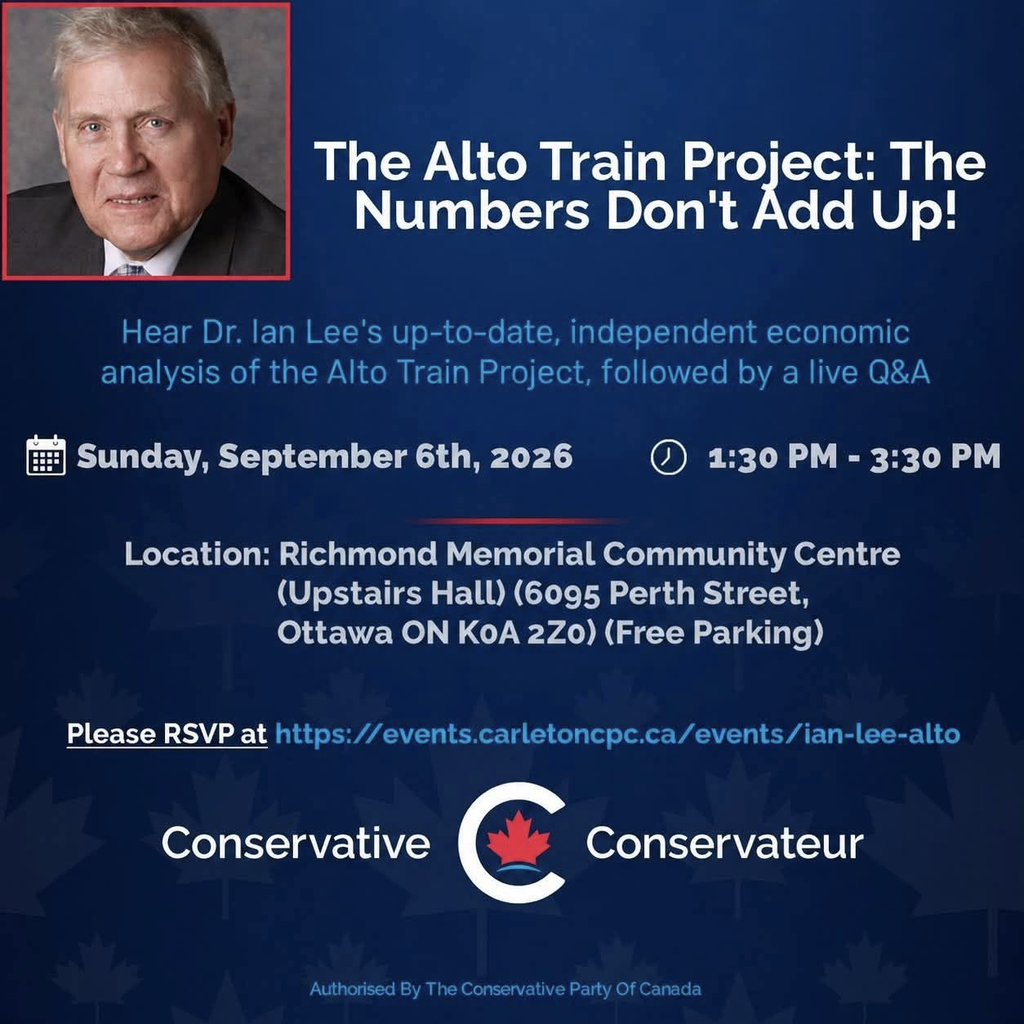
The Numbers Don’t Add Up! Say NO to Alto!
Please note that this event is open to the public.
Join the Carleton Conservative Association on Sunday, September 6, as Dr. Ian Lee, Associate Professor at Carleton University’s Sprott School of Business, breaks down the economic impact of the $90-billion Alto rail project.
Don’t miss out! Register today and say NO to Alto: https://events.carletoncpc.ca/events/ian-lee-alto
Details:
Sunday, September 6, 2026
1:30–3:30 p.m.
Richmond Memorial Arena, Upstairs Hall
6095 Perth Street, Richmond
From Richard Kent's Facebook page. As many of us suspected, the price of the Alto High-Speed Rail was underestimated ...
This should come under the heading of believe it or not! Erin Durant (and others) are reporting that:
Former Metrolinx CEO Phil Verster has been asked to Join Alto!
This has Toronto Transit users going into a panic. Vester failed as a manager at Metrolinx and now he has been hired by Alto.
Read why "this hire is just the latest in a series of optically bad decisions for Alto. It was a great way to alienate a base of supporters for the project. I never thought I’d see anyone from Toronto acknowledge that the Quebec farmers are right. I feel a bit more optimistic that people in Toronto will now pay closer attention to Alto and start asking their own questions. There are many that need to be answered and the more people asking questions, the better."
https://thealtofiles.substack.com/p/former-metrolinx-ceo-verster-to-join
Some heavy reading on the Alto High-Speed Rail project ...
For those of you who may have missed Dr Ian Lee's excellent presentation, a summary of his slides is attached.
Dr Lee references Andrew Hyett's research extensively in his presentation. See https://citizenresearch.ca/wp-content/uploads/2026/03/HSR_REPORT_2025.pdf for additional reading.
Check out this YouTube video of the rally in Rigaud on Saturday, September 19. Well done everyone!
Rebel News was at the Rigaud rally on Saturday, September 19. Great coverage! I see Ian Lee was one of the speakers.
Here is a very good article from Farmers Forum about the protest in Rigaud, including coverage of Professor Ian Lee's thoughts on the Alto High Speed Train.
EXPOSING LIES ABOUT ALTO HIGH-SPEED TRAIN: Costs to be over $200 billion, ridership not even close to projections, professor says
Read the article here: https://farmersforum.com/exposing-lies-about-alto-high-speed-train/
Listen to Cross Country Checkup "Are You On-Board for High Speed Rail in Canada?" tomorrow October 4 at 4-6 PM ET. If you miss it, you can also listen to the podcast.
Join the conversation - have your say.
Wyatt and Cheryl McWilliams joined Erin Durant at the federal Ag Committee to talk about Alto. Durant says Wyatt's extended family’s homes and businesses are throughout the corridor. They are longtime community volunteers. They all helped round up hundreds of farmers to get hay by train to the prairies to save livestock thousands of kilometres away for people they had never met and will never meet. Their network of incredible Canadians have also raised nearly 2 million pounds of beef for the Ottawa Food bank. Had there been any reasonable opportunity, don’t you think it’s obvious the McWilliams family would have been there?
Read Durant's full report here and catch a glimpse of the Committee meeting: https://substack.com/inbox/post/219515814?utm_source=email&redirect=app-store-no-desktop&inbox=true&utm_campaign=email-read-in-app&triedRedirect=true
