
Carney’s Plan To Take Our Land. By: MP Cheryl Gallant

In the December 2025 edition of the Ontario Landowners Newsletter, I warned Ontarians about Mark Carney’s plan to make it easier to expropriate land for a high speed rail line from Quebec City to Toronto. Included in the Liberal Budget Implementation Act are amendments to the Expropriation Act to prevent landowners from challenging the seizure of their land. The bill would also allow the Liberals’ new Crown Corporation, Alto, to effectively place a freeze on your property until the company decides if it truly requires your land. Under this freeze, property owners would be prevented from developing their property. 

Since the release of the Budget there have been two developments. The first is the launch of public consultations by Alto. The second is a market survey by the University of McGill. 

The consultations have provided Canadians with a look at the proposed corridor for the rail line. 
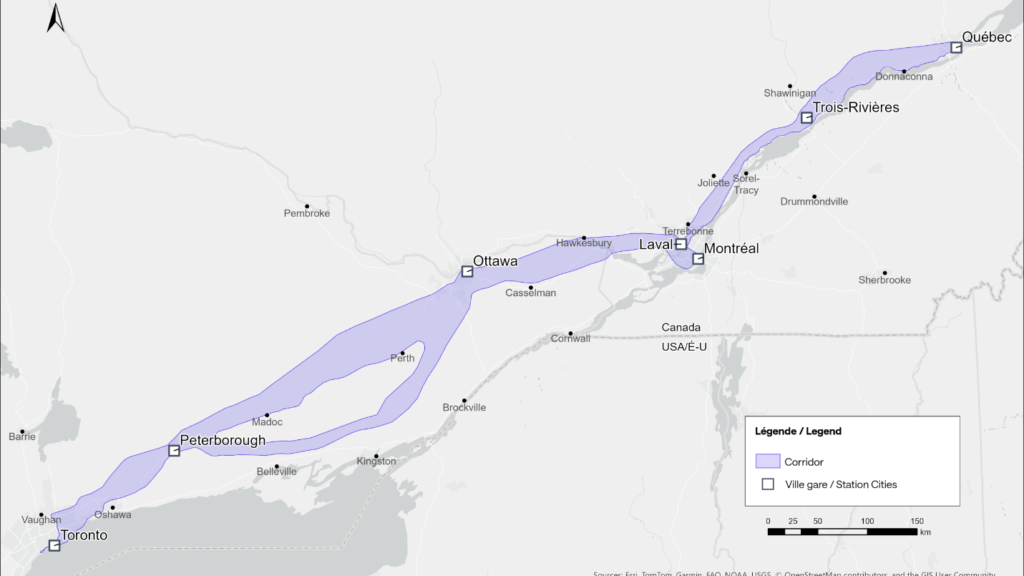
Below is an overlay of the corridor onto an Eastern Ontario map from Elections Canada.

We do not know the extent to which Alto plans on applying its power to freeze development along the corridor. To prevent property speculation, the Liberals may try to freeze first, then sort out the specific location for the final proposed rail line.

Along with the release of map, McGill University has released a market survey to estimate ridership and potential revenues. The results are troubling. The study found that as few as 11,000 Canadians living in Quebec City, Montreal, Trois Rivers, Ottawa, Peterborough, and Toronto would use the train each day. The region covered by the train has a population of 13,000,000.

More troubling than low ridership numbers is Canadians’ willingness to pay. For a trip from Toronto to Montreal, the survey found Canadians would be willing to pay $101 for a one-way ticket. For comparison, a one-way high-speed train ticket for a similar distance in France would cost $300 CAD. The study found that at a ticket price of $120, and with no drop in ridership from the estimated 11,000 daily passengers, high-speed rail will require over $60 billion in public subsides over the first 47 years of operation.

The study also provided additional estimates:

  • $79 billion for construction
  • $4.8 billion for trains
  • $5 billion for expropriation.

Given the expense of construction, and the Carney Liberals out-of-control spending, and massive deficits, it is unlikely this project will ever begin construction. The Liberals will still seize the land. It just won’t be used for a rail line. Instead, they will keep the land until they can quietly turn it into a protected wildlife corridor as part of their commitment to restore 30% of Canada’s developed land by 2030.

The Line Drawn in the Sand: Defending Crown Land Patents by Kythe Baldwin

In our first submission, we spoke about standing firm. https://ontariolandowners.ca/standing-firm-property-rights-battles-in-haliburton-county-by-kythe-baldwin/ 

This installment goes further.

It is about the original line drawn in the sand — and whether that line still means anything in Ontario.

When the Crown surveyor laid out the township fabric in the 1860s, he physically marked the boundaries of each concession and lot. Along navigable waters, a strip was sometimes set aside — the Original Shore Road Allowance (OSRA). It was measured. It was plotted. It was recorded.

That line was not symbolic. It was surveyed. It was fixed.

Later, when the Crown issued a Crown Land Patent, that patent determined whether the OSRA survived — or whether it was extinguished.

If the patent reserved it, it remained Crown land.
If the patent did not reserve it, it passed to the grantee.

That is the foundation of Ontario land law.

The dispute on Maple Lake is not about modern road maintenance. It is not about administrative convenience. It is about whether that original line drawn in the sand can be ignored, shifted, or recreated decades later — despite what the patent says.

That is the line we are defending.

Notice Was Given — Repeatedly

The Township of Algonquin Highlands has been on repeated notice. Multiple cease-and-desist letters were issued advising that the Crown Land Patent for the subject properties contains no reservation for a Shore Road Allowance. No expropriation appears on title. No dedication appears on title. No conveyance to the Township appears on title.

The Township was asked to produce a root of title supporting its claims.

Instead, HCLA signage was removed — not once, but three separate times. Each removal was documented. Photographic evidence exists.

From Correspondence to Small Claims Court

After repeated notice was ignored, Small Claims proceedings were commenced. The claim is straightforward: if the Township asserts ownership, it must prove ownership. If it removes property from private land, it must justify its authority.

The Township’s response has relied heavily on Section 26 of the Municipal Act, suggesting that historic maintenance establishes municipal interest. But Section 26 does not create title; it presupposes title already exists.

The Township’s Position on Patents

During proceedings, the Township’s position has been that Crown Land Patents are irrelevant to the ownership question. That position strikes at the core of Ontario’s land system.

Ontario courts have said otherwise.

In Gall v. Rogers (1993 OCA), the Court confirmed that where boundary disputes arise, the best original evidence governs — typically the original Crown survey and patent.

In Palmer v. Thornbeck (1963 Ont.), the court affirmed that where a patent contains no reservation, the grantee receives full conveyance.

In Attorney General v. Walker (1975 OCA), the Court reinforced that Crown reservations must be explicit and cannot be implied decades later.

Patents are not irrelevant. They are determinative.

Escalation: Licence of Occupation and Engineering Intrusion

The matter has escalated beyond signage removal. Licence of Occupation claims and additional Small Claims actions address engineering plans and construction affecting privately titled land.

Under Annapolis Group Inc. v. Halifax (2022 SCC), government conduct that effectively appropriates private land without compensation may constitute constructive expropriation.

Heavy equipment cannot relocate the original survey line. Administrative reliance cannot redraw the sand.

Where Things Stand

Cease-and-desist notices have been issued. Photographic evidence has been preserved. Small Claims proceedings are underway. Engineering encroachment issues are before the court. The Minister has been contacted under the Boundaries Act.

This is now litigation grounded in established property law principles.

Stay Involved

The Haliburton County Landowners Association will continue to pursue lawful remedies and defend the integrity of Crown Land Patents.

Website: www.haliburtoncounty-ola.ca
Email: kythe@haliburtoncounty-ola.ca

Support for ongoing legal initiatives can be made through our GoFundMe campaign.

Clarity begins with the patent.

And the patent begins with a line drawn in the sand.

Leave a Reply